- Born: December 15, 1925, Fort Smith, Arkansas
- Died: December 4, 1992, Sapulpa, Oklahoma
- Military service: United States Navy, World War II
- Relationship: My grandfather
Raymond Edward Wegley was my grandfather. He was born on December 15, 1925, in Fort Smith, Arkansas, the son of Frederick Wegley and Tillie Blanch Edwards.
Raymond was born during the final years of the period remembered as the Roaring Twenties, but his childhood would soon be shaped by a very different America. He was only three years old when the Great Depression began and was still a teenager when the United States entered World War II.
- The 1920s were defined by a booming economy, often called the “Roaring Twenties.” This era was characterized by the growth of consumer goods industries, mass production (such as Ford’s assembly line), and increasing urbanization.
- As a regional hub, Fort Smith, Arkansas, likely felt some of this economic prosperity but remained largely rural and agricultural compared to urban centers.
- Prohibition was in full swing in 1925 (1920-1933), making the production, sale, and transportation of alcoholic beverages illegal under the 18th Amendment. Speakeasies, bootlegging, and organized crime marked this era.
- In rural areas like Arkansas, temperance movements were often followed more strictly, though illicit moonshining was widespread.
- The South, including Arkansas, was deeply segregated due to Jim Crow laws. These laws enforced racial discrimination and limited opportunities for African Americans. At the same time, Black communities were creating vibrant cultural and social institutions despite systemic oppression.
- Radio technology was transforming communication and entertainment. By 1925, radios were becoming more common in homes, bringing music, news, and sports broadcasts to people nationwide.
- Automobiles were also becoming more accessible, reshaping rural and urban life.
- The world was still recovering from the devastation of World War I (1914-1918). The League of Nations, though the U.S. did not join, attempted to mediate international conflicts and promote peace.
- In Europe, Benito Mussolini had consolidated power in Italy by 1925, signaling the rise of fascism as a political force. This would later have profound global implications.
- Jazz music and the Harlem Renaissance were influencing culture worldwide, spreading from the U.S. to Europe.
- In December 1925, F. Scott Fitzgerald’s The Great Gatsby was still fresh in people’s minds, capturing the era’s glitz and disillusionment.
Born in Fort Smith
Raymond’s Arkansas birth certificate confirms he was born in Fort Smith on December 15, 1925. It also identifies his parents as Frederick Wegley and Tillie Blanch Edwards, providing contemporary documentation of his place within the family.
Although Raymond was born in Arkansas, the family did not remain there permanently. Later records connect him closely with southwestern Pennsylvania, where his father worked in the glass industry and where Raymond lived when World War II changed the direction of his young life.
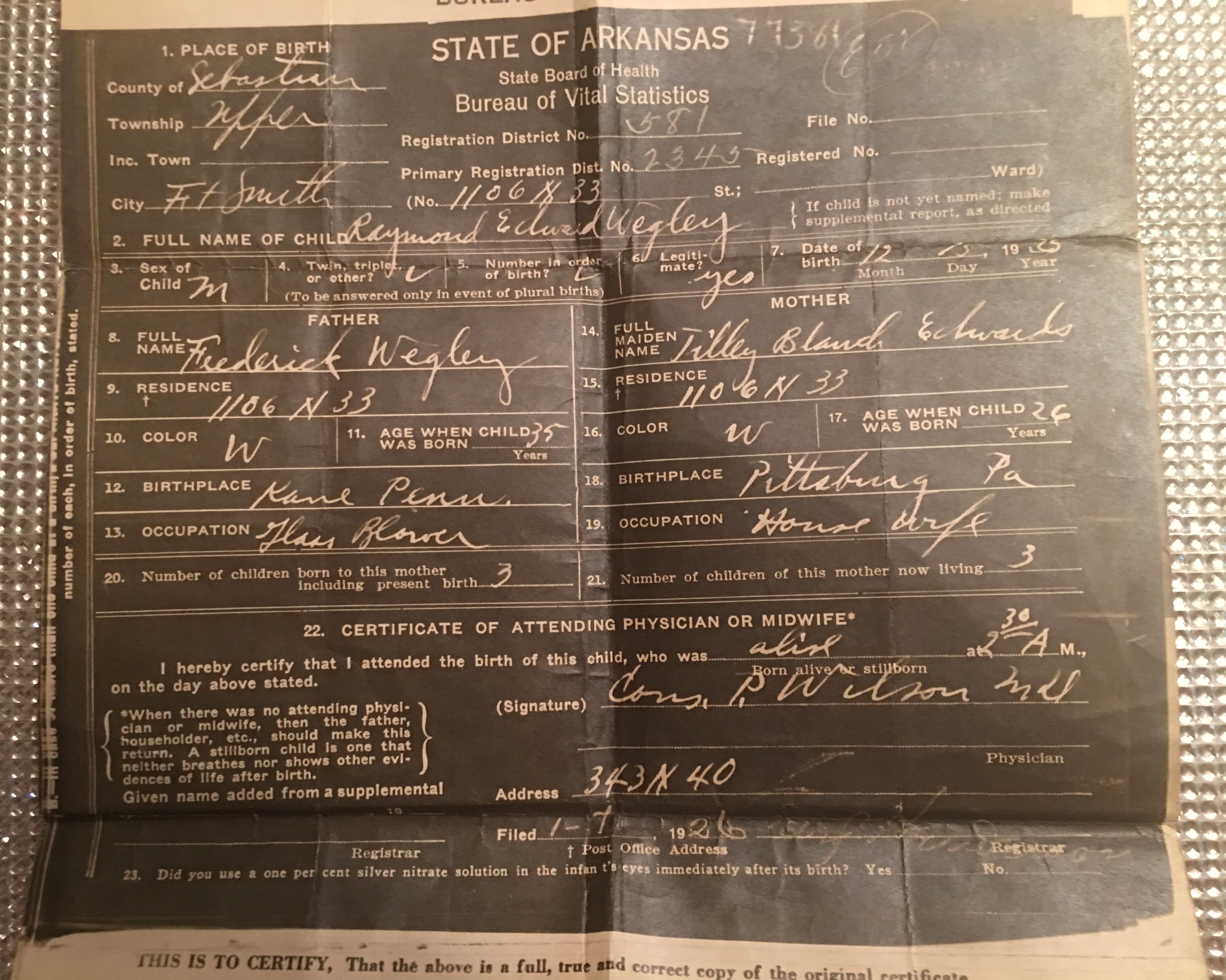
| Field | Information |
|---|---|
| Document type | State of Arkansas birth certificate |
| Full name | Raymond Edward Wegley |
| Sex | Male |
| Date of birth | December 15, 1925 |
| Time of birth | Approximately 2:30 a.m. |
| Born alive | Yes |
| Legitimate birth | Yes |
| County of birth | Sebastian County, Arkansas |
| Township | Upper Township |
| City of birth | Fort Smith, Arkansas |
| Street/address associated with birth | 1106 N. 33rd Street |
| Registration district no. | 581 |
| Primary registration district no. | Appears to be 2345 |
| Father’s full name | Frederick Wegley |
| Father’s residence | 1106 N. 33rd Street |
| Father’s race/color | White |
| Father’s age when Raymond was born | 35 |
| Father’s birthplace | Kane, Pennsylvania |
| Father’s occupation | Glass blower |
| Mother’s full maiden name | Tillie Blanch Edwards |
| Mother’s residence | 1106 N. 33rd Street |
| Mother’s race/color | White |
| Mother’s age when Raymond was born | 26 |
| Mother’s birthplace | Pittsburgh, Pennsylvania |
| Mother’s occupation | Housewife |
| Children born to Tillie including Raymond | 3 |
| Children of Tillie then living | 3 |
| What the child count tells us | Raymond was Tillie’s third child, and all three children were living when he was born |
| Attendant | Physician: signature appears possibly to be Cora P. Wilson, M.D., but I would treat the name as uncertain |
| Physician’s address | Appears to include 313 N. 40, but the complete address is not clear enough to state confidently |
A Family Connected to the Glass Industry
Raymond’s father, Frederick Wegley, worked in the glass industry, as did other family members. Glass manufacturing became an important thread running through several generations of the Wegley family.
Raymond would eventually continue that tradition himself. After the war and his move to Oklahoma, he spent much of his working life at the Bartlett-Collins Glass Company in Sapulpa.
World War II
Raymond entered the United States Navy on November 29, 1943. Because he would not turn eighteen until December 15, he was still seventeen years old when his service began.
He was only about two weeks short of his eighteenth birthday, so his age should not automatically be taken as evidence that he lied to enlist. The records presently available do not tell us whether parental consent or another enlistment procedure was involved.
Raymond’s older brother, John Wesley Wegley, entered the United States Army earlier that year, in February 1943. The two brothers therefore served simultaneously during World War II, but in different branches of the armed forces.
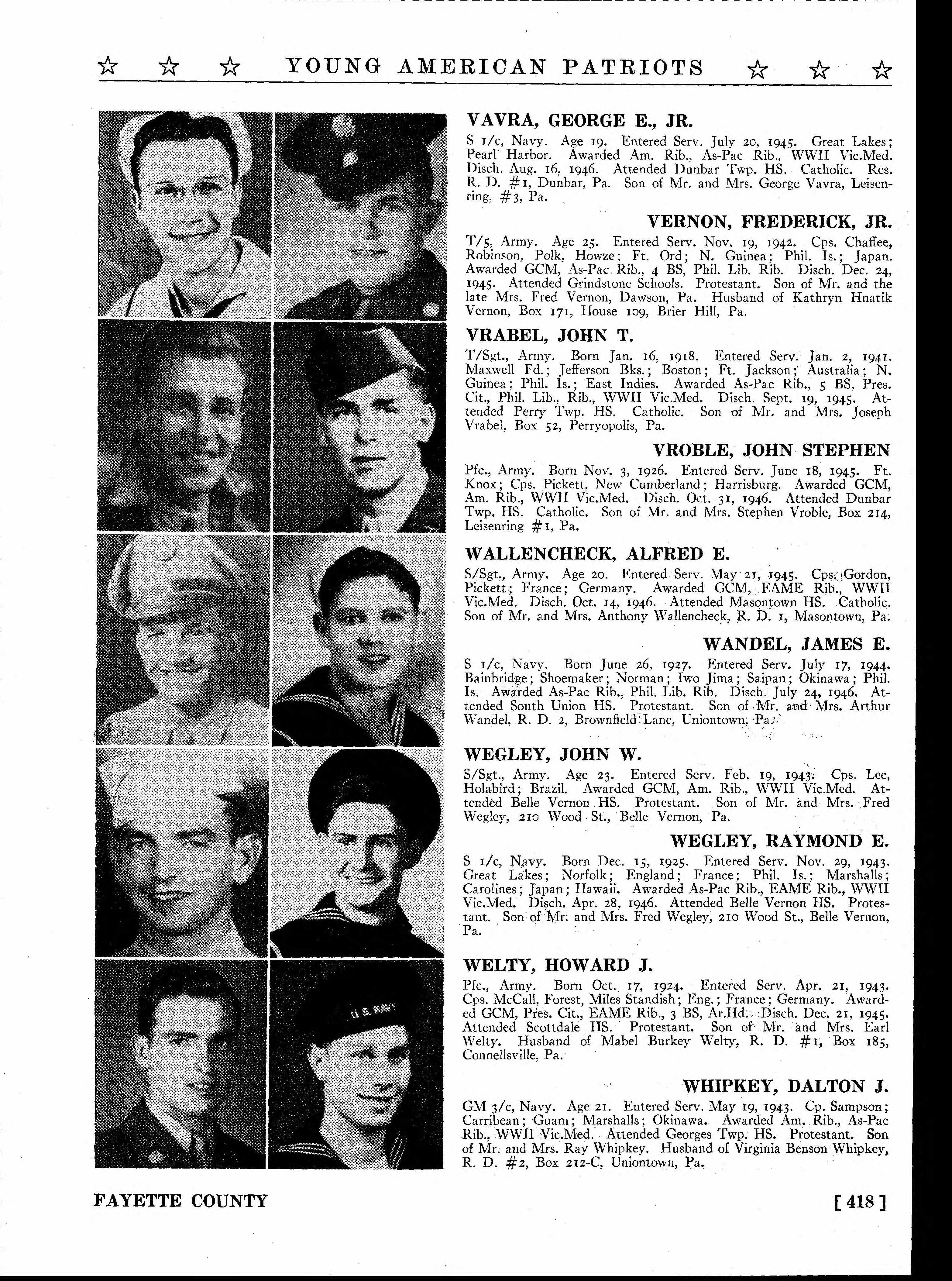
Seaman First Class Raymond Wegley
A Young American Patriots record identifies Raymond as a Navy serviceman and supports his rank as Seaman First Class, commonly abbreviated S1/c. This is an important correction to an earlier version of this page that mistakenly described him as a Sergeant First Class. This matters because Sergeant First Class is an Army rank. Raymond was a sailor, and the surviving records consistently place his wartime service in the United States Navy.

USS Earl K. Olsen
Raymond served aboard the USS Earl K. Olsen (DE-765), a Cannon-class destroyer escort. The vessel was named for Lieutenant Commander Earl Kenneth Olsen, who received the Navy Cross posthumously for his actions during the Battle of Tassafaronga.
Destroyer escorts were designed primarily to protect convoys and other ships from submarines and aircraft. During World War II, the Earl K. Olsen participated in Atlantic convoy operations and later served in connection with operations extending into the Pacific.
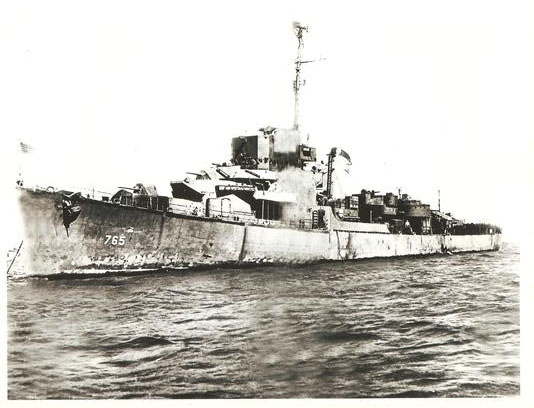
Between August 1944 and May 1945, the ship completed multiple convoy escort voyages between the United States and ports in the United Kingdom. These voyages were part of the enormous Allied effort required to move troops, equipment, supplies, and vessels safely across the Atlantic.
One dramatic event in the ship’s history occurred on March 13, 1945, when the U.S. Army transport J. W. McAndrew collided with the French aircraft carrier Béarn during a violent storm. The Earl K. Olsen participated in the response and assisted the damaged vessels as they made their way toward the Azores.
Unless Raymond’s individual Navy records place him aboard for that particular voyage, I would describe this as part of the ship’s history rather than state conclusively that Raymond personally took part in the rescue. His service aboard the vessel nevertheless placed him within the larger wartime convoy system that was essential to Allied operations.
More Than Two Years in the Navy
Raymond remained in military service until April 28, 1946. His Navy service therefore lasted approximately two years and five months, extending beyond the end of World War II in August 1945.
His Pennsylvania veterans’ compensation application provides additional documentation of his wartime service. It identifies Raymond Edward Wegley, gives his birth in Fort Smith, Arkansas, and records his military service before his return to civilian life.
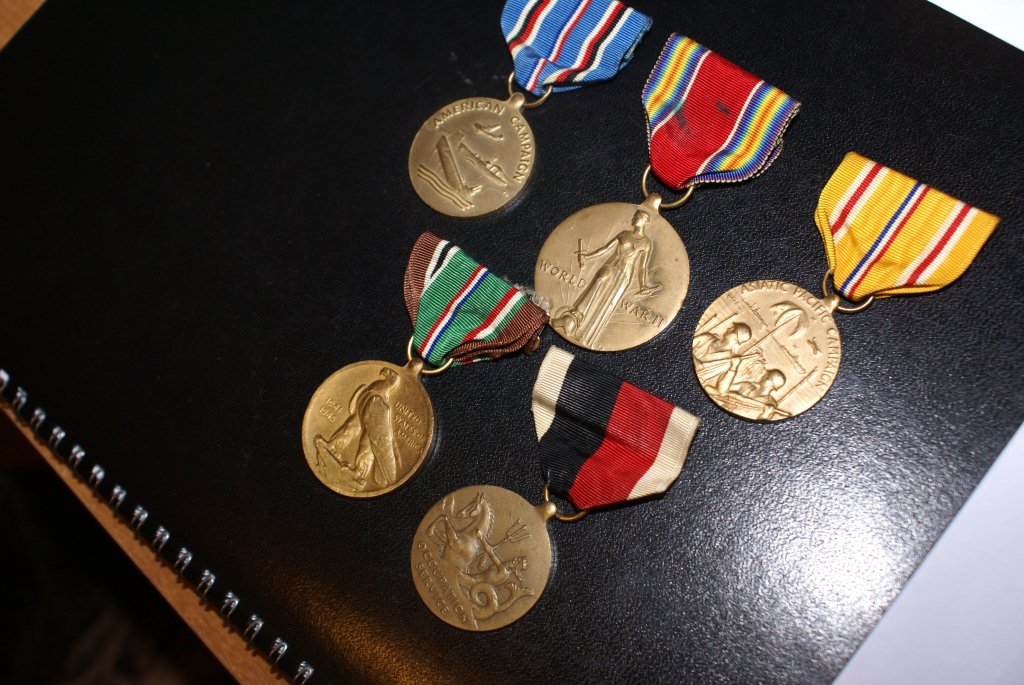
Family records also preserve the military decorations associated with his Navy service. Those medals represent a period of his life that began while he was still seventeen and ended when he was twenty years old.
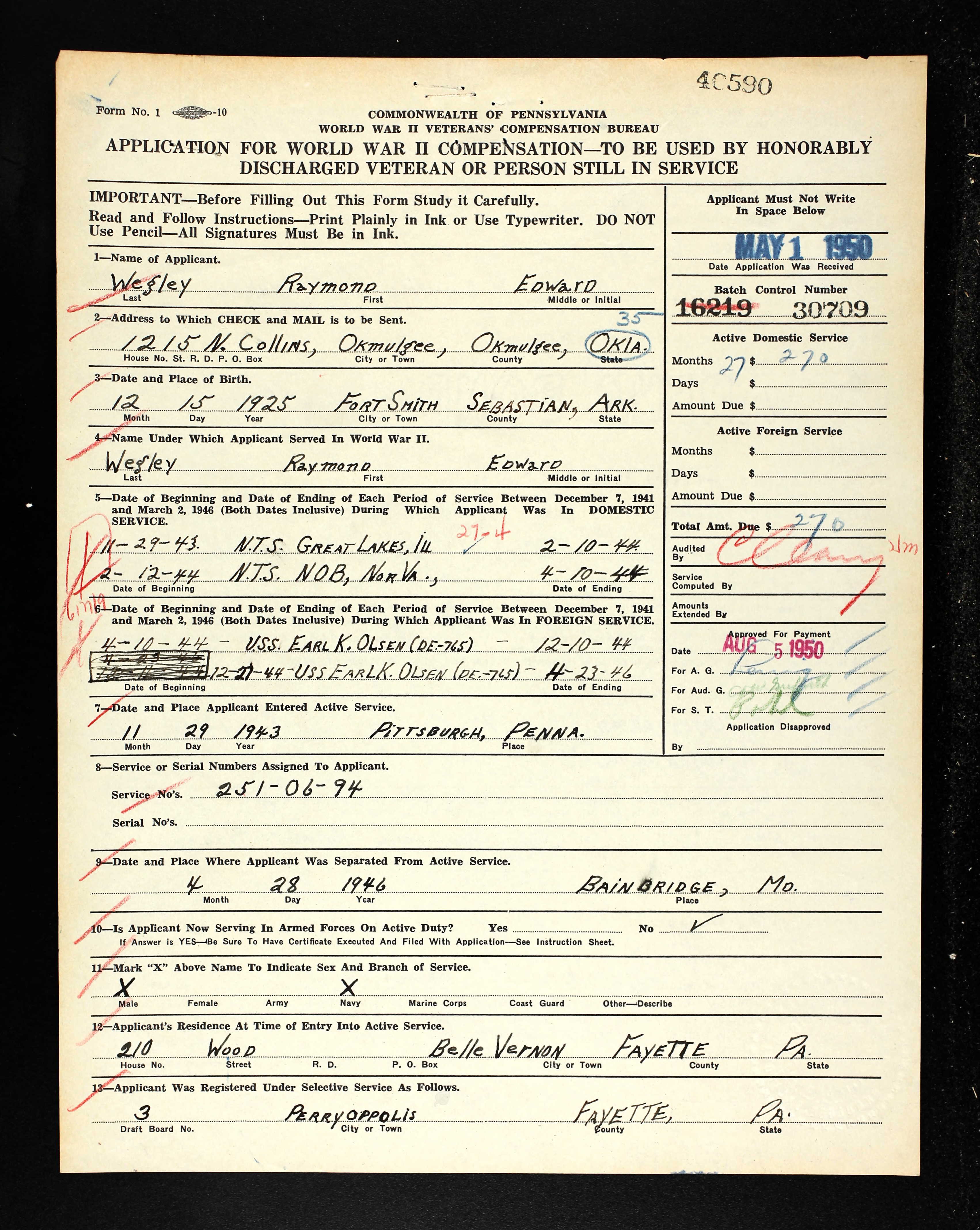
| Field | Information |
|---|---|
| Document | Commonwealth of Pennsylvania World War II Veterans’ Compensation Bureau application |
| Applicant | Raymond Edward Wegley |
| Application/file number | 40580 |
| Address when application filed | Appears to read 120 S. M. Collins, Okmulgee, Okmulgee County, Oklahoma |
| Date of birth | December 15, 1925 |
| Birth city | Fort Smith |
| Birth county | Sebastian County |
| Birth state | Arkansas |
| Name used during World War II service | Raymond Edward Wegley |
| Domestic service period 1 | November 29, 1943 to February 10, 1944 |
| Station during period 1 | N.T.S. Great Lakes, Illinois |
| Domestic service period 2 | February 10, 1944 to April 10, 1944 |
| Station during period 2 | N.T.S. N.O.B., Norfolk |
| Foreign/service period 1 | April 10, 1944 to December 10, 1944 |
| Ship during period 1 | USS Earl K. Olsen (DE-765) |
| Foreign/service period 2 | December 27, 1944 to April 23, 1946 |
| Ship during period 2 | USS Earl K. Olsen (DE-765) |
| Date entered active service | November 29, 1943 |
| Place entered active service | Pittsburgh, Pennsylvania |
| Navy service number | 251-06-94 |
| Date separated from active service | April 28, 1946 |
| Place separated from active service | Bainbridge, Maryland |
| Still on active duty when application filed? | No |
| Sex | Male |
| Military branch | United States Navy |
| Residence when entering active service | 210 Wood Street, Belle Vernon, Fayette County, Pennsylvania |
| Selective Service draft board | Board No. 3 |
| Selective Service location | Perryopolis, Fayette County, Pennsylvania |
| Application received | May 1, 1950 |
| Batch control number | Appears to have been changed from 16219 to 30709 |
| Domestic service credited for compensation | 27 months |
| Domestic-service compensation | $270 |
| Foreign-service compensation | None shown in the final calculation |
| Total compensation approved | $270 |
| Approved for payment | August 5, 1950 |
Coming Home
Raymond returned from military service in the spring of 1946. Like millions of other young Americans, he now faced the task of moving from wartime service back into an ordinary civilian life. Within two years, that new life had begun to take shape. On June 5, 1948, Raymond married Elsie Jane Hoag in Pennsylvania.
Marriage to Elsie Jane Hoag
Raymond and Elsie would remain together for the rest of his life. Their marriage also marked the beginning of the Oklahoma branch of the family that I knew personally. Soon after their marriage, Raymond and Elsie were living in Oklahoma. Their first child was born in Okmulgee little more than a year after the wedding.
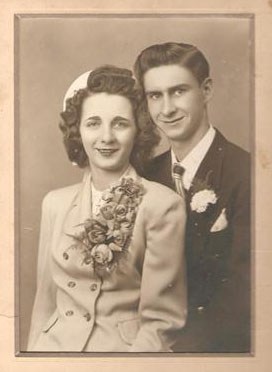
Together they had four children:
- Thomas Eugene Wegley, June 13, 1949 to May 1, 2026
- Karen Marie Wegley, born January 26, 1951
- Raymond Edward Wegley Jr., December 11, 1952 to February 12, 2021
- Robert “Bobby” Thomas Wegley, born September 27, 1954
Their three sons and one daughter created another generation of the Wegley family firmly rooted in Oklahoma.
Building a Life in Oklahoma
Raymond eventually settled with his family in the Sapulpa area. The move marked another significant step in this branch of the Wegley family’s geographic journey, as earlier generations had lived primarily in Pennsylvania.
Oklahoma became Raymond’s permanent home. He raised his children there, spent much of his working life, retired, and ultimately died.
Bartlett-Collins Glass Company
Raymond worked for the Bartlett-Collins Glass Company in Sapulpa, Oklahoma. In this way, his adult career continued an occupational tradition already present among his father and other members of the Wegley family.
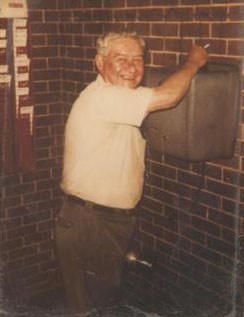
A surviving family photograph was taken on Raymond’s last day of work in April 1989. It captures an important milestone because his retirement ended a working life that stretched from the World War II generation into the closing years of the twentieth century.
Retirement
Raymond had only a few years to enjoy retirement. After leaving Bartlett-Collins in April 1989, he remained in Sapulpa with Elsie. His retirement photograph has become especially meaningful because it preserves him at the conclusion of his working life. Less than four years later, the family would lose him.
December 4, 1992
Raymond Edward Wegley died on December 4, 1992, in Sapulpa, Oklahoma. He was sixty-six years old and only eleven days away from his sixty-seventh birthday. According to the family information and death records preserved with this history, Raymond died in his sleep following a heart attack. He died a little more than three years after retiring from Bartlett-Collins.
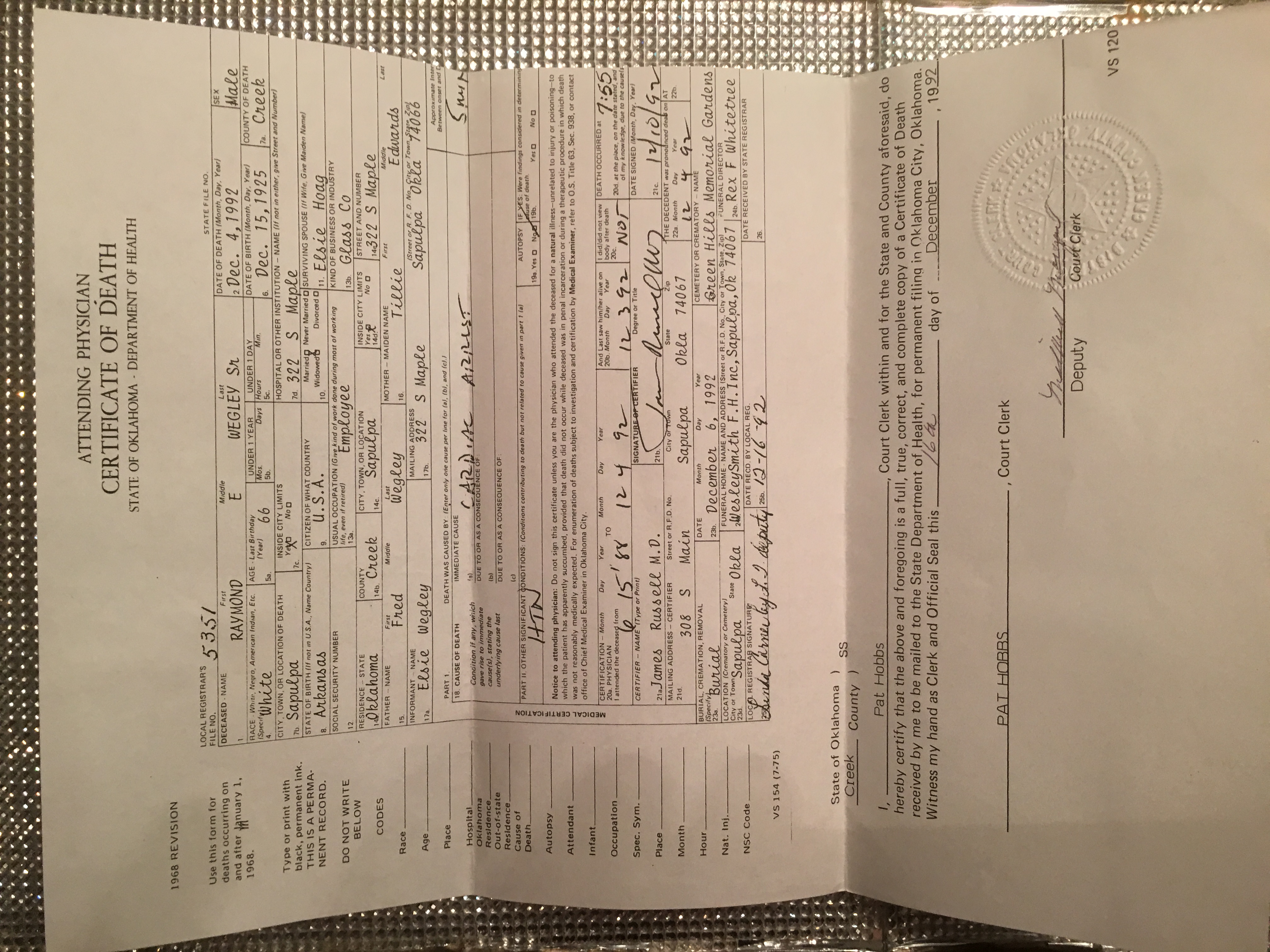
| Field | Information |
|---|---|
| Document type | Attending Physician Certificate of Death, State of Oklahoma |
| Full name | Raymond E. Wegley Sr. |
| Sex | Male |
| Race | White |
| Date of birth | December 15, 1925 |
| Age at death | 66 |
| Birthplace | Arkansas |
| Citizenship | U.S.A. |
| Marital status | Married |
| Surviving spouse | Elsie Hoag |
| Date of death | December 4, 1992 |
| County of death | Creek County, Oklahoma |
| City of death | Sapulpa, Oklahoma |
| Place of death | 322 S. Maple, Sapulpa, Oklahoma |
| Death occurred inside city limits | Yes |
| Hospital or institution | None; street address of death is given instead |
| Usual occupation | Employee |
| Kind of business or industry | Glass Co. |
| Residence state | Oklahoma |
| Residence county | Creek County |
| Residence city | Sapulpa |
| Residence inside city limits | Yes |
| Home address | 322 S. Maple, Sapulpa, Oklahoma 74066 |
| Father | Fred Wegley |
| Mother’s maiden name | Tillie Edwards |
| Informant | Elsie Wegley |
| Informant’s address | 322 S. Maple, Sapulpa, Oklahoma 74066 |
| Immediate cause of death | Cardiac arrest |
| Approximate interval between onset and death | 5 minutes |
| Other significant condition | HTN, meaning hypertension/high blood pressure |
| Autopsy performed | No |
| Physician attended Raymond from | January 15, 1984 |
| Physician attended through | December 4, 1992 |
| Last seen alive by physician | December 3, 1992 |
| Physician viewed body after death | No |
| Time death occurred | 7:55 |
| Certifying physician | James Russell, M.D. |
| Physician’s address | 308 S. Main, Sapulpa, Oklahoma 74067 |
| Certificate signed | December 10, 1992 |
| Date pronounced dead | December 4, 1992 |
| Disposition | Burial |
| Burial date | December 6, 1992 |
| Cemetery | Green Hills Memorial Gardens |
| Cemetery location | Sapulpa, Oklahoma |
| Funeral home | Wesley Smith F.H. Inc. |
| Funeral home location | Sapulpa, Oklahoma 74067 |
| Funeral director | Rex F. Whitetree |
| Received by local registrar | December 16, 1992 |
| Local registrar file no. | 5351 |
Burial
Raymond was buried at Green Hill Memorial Gardens in Sapulpa, Oklahoma. The cemetery became his final resting place in the community that had been his home for much of his adult life.
His burial in Oklahoma stands in contrast to the Pennsylvania cemeteries where so many earlier generations of Wegleys were laid to rest. By Raymond’s generation, the family’s geographic center had shifted dramatically westward.
My Grandfather
Unlike many of the people in this family tree, Raymond Edward Wegley is not someone I know only through census pages, certificates, and fading handwriting. He was my grandfather, which makes preserving his story fundamentally different from reconstructing the life of an ancestor who died a century before I was born.
The official records give us the framework of his life, but family photographs and memories add another dimension. They preserve Raymond as a sailor, husband, father, grandfather, glass worker, and eventually a retiree enjoying the years he had earned after a lifetime of work.
Raymond’s Place in the Wegley Story
Raymond’s life connects several important chapters of the Wegley family’s twentieth-century history. He was born in Arkansas to parents with deep Pennsylvania roots, returned to Pennsylvania as a young man, joined the Navy before his eighteenth birthday, served during World War II, married Elsie after coming home, and then built his family’s future in Oklahoma.
His story also carries forward occupations and traditions found elsewhere in the family. The son of a glass worker became a glass worker himself, while the young sailor who went to war in 1943 eventually became the father of four children and the grandfather of another generation.
For me, though, those historical connections are only part of why his story matters. Raymond Edward Wegley was my grandfather, and preserving his life means recording not only where he fits on the family tree, but also the man who helped create the family I knew.